See What Children Know
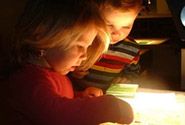
Click on the thumbnail to watch this video inside our video library.A faceted mirror ball sprays rays of light throughout the room, radiating outward from the ball, but only when the ball is placed in the path of sunlight coming through the window. Carter created this effect just before the clip began. The action picks up with Carter asking, “Where’d go?” holding his palms up in a questioning gesture. He holds the mirror ball and has stepped out of the path of sunlight. The question itself indicates that Carter wonders if these delightful spots of light will return. He searches with his eyes, sees a single spot, and points to it. Again his behavior suggests he understands this event to be repeatable, not a one-time “pop”.
He cradles the mirror ball to his shoulder, more to stabilize the weight of it than to extend it into the light. As his torso moves, so does the ball. His movements to look for the light fortuitously move the ball into the sun. For a split second reflected spots zoom about him in a synchronized pattern. This display excites him and confirms his belief that the spots do return. Then, in a flash, they are again nowhere to be seen.
The teacher senses Carter’s curiosity and asks rather rhetorically, “Where did they go?” The teacher does not literally expect Carter to say where in the room live the spots. Her question is more an acknowledgement that the spots, once here, are now gone. But in a gesture that has the look of an answer, Carter points to the floor, touching it, and says, “Go,” as if to say, “They were right here but are now gone.” The teacher is quick to adjust her question about the place of the missing stars to the place they could reappear. “You want the stars to go on the mat?” The teacher carefully phrases her question to refer to a specific place (the mat) that can be seen, rather than an unspecified place that hides the missing stars. She also cleverly gives Carter a tangible goal and a hint about the means, “So where are you going to move the ball so the stars will go on the mat?”
Was this too much of a hint? Or was it simply no hint at all because Carter has no idea that the ball created the stars? Carter seems to pick up on at least the reference to the ball. He holds it up. Then he mentions again the condition that he wants to reverse, “All gone,” referring to the stars. At this point we only know that “ball” has become a character in the play, even though its relation to the stars has not been established. To Carter’s comment, “All gone,” the teacher infers a question and answers, “I don’t know where it went.” Adults often have to infer a child’s intent from the context, even when an interrogative sounds like a declarative sentence. The teacher also remembers that Carter has been pointing to single spots, so she uses the word “it” instead of bowing to Carter’s plural word “all.” Again, a good teacher will be as observant of a child’s action as she is to the child’s words.
Carter leans forward, ostensibly to have a better look at the floor. Once again his torso movement coincidentally, but not intentionally, causes the ball to enter the stream of sunlight. A galaxy of stars floods the floor and then extinguishes, as Carter stands erect. He is quite perplexed. One wonders if he is making some intuitive, semi-conscious connection between his movements and the appearance/disappearance of the stars. He says, “There!” as he point to the now starless floor. “Where’d it go?” asks the teacher. Carter, using a classic gesture of upward extended palms, shrugs as he says, “Ohhhh,” no doubt an indication that he knows he does not know.
The teacher turns her attention away from Carter for a moment. We hear loud drumming in the background. Carter begins to walk away. As he walks, something causes him to bend at the waist, holding the ball in both hands in front of him. As the mirror ball enters the path of light, the reflected stars fall on the floor and on his clothes. The starlights move when he moves. But how will he isolate the source of these lights to the ball? So far he has not moved the ball while he stands still. He could just as easily think that his body causes the stars to appear.
Notice how the pattern of stars radiates from the ball. For the first time Carter begins to think about the ball as the source of the lights 1) because the ball is in his line of view as he sees the lights move in synchrony with the ball, and 2) because the pattern of the lights virtually “points” to the ball as its source. The teacher knows to “mark” this moment as a discovery, simply by uttering, “Ohh,” when she senses that Carter has noticed something significant. Carter has released the ball on the floor and, for the first time, moves the ball independent of moving his body. As the ball rolls into the sunlight, the stars spray in radii from the mirror facets. The teacher catches the ball and rolls it back, but is careful to make its movement pass slowly through the sunlight to give Carter more evidence of the interplay between the mirror ball and the stars. He gets it. He gingerly directs the ball into and out of the patch of sunlight on the floor, taking great notice of the resulting appearance and disappearance of the stars. At the end of the video clip he gives a satisfied, “There,” as he points to a star, now stationary because the ball lays dormant on the floor in the sunlight. The teacher consolidates his pleasure by affirming his observation. She says, “I see it.” Carter touches the star one more time, stands with authority, and says loudly, “I see it.”
This short video clip captures some interesting teacher-child interactions. The teacher scaffolds Carter’s curiosity by being his audience, by asking him to solve a problem, by affirming his discovery, by adjusting to simpler questions when a more difficult question does not connect, by using the word, “it” when she notices that he points to single spots, and by maximizing the display of the effect when she moves the ball into the patch of sunlight. This video also shows what a young child has to do to isolate the cause of an event and test a hypothesis. He initially thought that his movements could control the appearance of the lights and then, by degrees, he isolated the source of the lights to the ball. To test this hypothesis, he moved the ball on the floor, independent of his body movements. We speculate that he does not yet know that the stars are reflected sunlight. But he does know that moving the ball moves the spots, and he may have some idea that this movement has to be near the patch of light on the floor. It is too much to expect him to know that “light” is everywhere, a beam that passes invisibly through the air. It takes time to understand the geometry of optics.
Click here to purchase a high resolution file of this video clip plus the supporting text analysis.
To subscribe to our streaming video library of over 225 video clips with supporting text, click here.