Videatives Views

See What Children Know


Videative Views Video
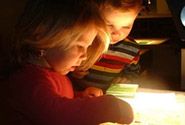
Your first impression in watching this video clip of water play might be that the teacher asks the children many questions. But we must be careful to analyze the form of a conversation before discussing it. How often does the teacher ask the children to provide a strategy to solve a problem? Does the teacher accept a child’s strategy or suggest a counter-strategy? Does the teacher give an explicit reason for what she is doing, sort of “thinking out loud?”

We have provided you a link to the full transcript of this video. The full transcript also presents an example of one way to discover the general form of a conversation – coding each sentence according to categories such as goals, strategies, problem, and so on. Through your careful reading of the transcript, you might deem this conversation “science talk” in that questions are asked about goals, strategies are offered and revised, and new goals emerge from older ones. Below is an excerpt from the video clip.

T: You want to put the tube….Where do you want to put it?

C1: Into the water, so I can do that.

T: In there; how are we going to do that?

C1: You have to lift me up.

T: I have to lift you up, all right.

C: It’s … Why is it stuck?

T: I don’t know. Should we look inside?

C1: Yeah.

Watch the entire clip in the Videatives Video Streaming library. Do you think this episode models a form of discourse that the children might use later on their own? Do you think that goals always need to come from the child(ren)? Does this video offer a good example of co-construction of knowledge? If not, how would you change the dialogue? Click here to download a PDF of the entire transcript with coded sentences. Click here to purchase a high-resolution copy of the video that also includes the transcript.

Notes from the Field

How can we help children make their thinking visible? Pre-K children at the Mid Pacific Institute in Honolulu teamed with high school students to create computer animations of the wind. The children had been observing the winds of Oahu for weeks. Each child adopted and named a type of wind, based on movement pattern, location, and effect. The children created stories about their wind and used markers to represent these stories as theory drawings. The drawings were transferred to a computer, using a graphic tablet, and animated by the high school students, following the children’s instructions. The animations appear on YouTube for all to see. Click here and enjoy. Be sure to click on “more info” in the box on the right to read about the stories and their meanings.

A Mega Wind project has been launched to extend research about what children know around the constructs of wind, using the children’s wind animations as a provocation. Fourteen schools from around the globe have begun a collaborative dialogue, using Moodle (an online forum) to explore what children know, using the wind as its context. If you are interested in the Mega Wind project, please send an email to Leslie Gleim at lgleim@midpac.edu

Share and Enjoy:
  • Print
  • email
  • PDF
  • Twitter
  • Facebook
  • Digg
  • del.icio.us
  • LinkedIn
  • Reddit
  • StumbleUpon
  • Google Bookmarks
  • Add to favorites

Leave a Reply