Videatives Views

See What Children Know


Videative Views Video
What does a young child think it means to give a full explanation of a physical event, such as why a golf ball curves as it rolls toward the hole or why a piece of clay sinks in water? At first the child offers the effect as the reason. When asked, “Why does the clay sink?” she might say, “Because it goes down.” A slightly more advanced answer would be “because it cannot float.” The child at this stage does not make a clear distinction between the cause and the effect. It is as if she hears your question as “what happened?” instead of “what made that happen?” Also, the child thinks that either an object floats or does not float. It would not occur to her that reshaping the clay that sinks might make it float. By five, the child begins to understand that the effect is the result of some condition or attribute that is not, in itself, the same as the effect nor a constant result of being a piece of clay. “Because it is heavy” appears at this stage of understanding. The child knows that clay is sometimes heavy and sometimes light. While the words sound more advanced, actually the child has done little more than rename the different effects. She attributes heavy or light by looking at the effect instead of by some independent method such as hefting the object in her hand. If it sinks, it must be heavy; if it floats, it must be light. Yet the child’s felt need to offer more than a restatement of the effect (“It goes down.”) does mark a slight advance in the child’s understanding of what it means to explain an event in terms of attributes that can vary.

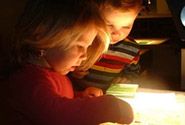
Now watch Nichole, who just turned five years of age, demonstrate how to make a ball of clay float. Listen carefully to her responses to her mother’s questions. (We thank Dr. Angela K. Salmon from Florida International University for producing this video interview with her daughter Nichole). When you click through to the video in our Videatives Video Streaming library, you will see a few speculations on what Nichole is thinking. There is some progression in her thinking as she works. Please add your own speculations in the Videatives Views blog.

——– To gain access to our entire Videatives Video Streaming library, click here to purchase an inexpensive subscription to over 150 video clips with text. This library grows every month. You can send your favorite clips to colleagues and students at no extra charge.

Notes From the Field

Last Call for The Power of Digital Video Workshop: In two weeks we will close applications for our workshop in Boulder to be held on September 22. Click here to learn more about both the workshop and the study tour of the Boulder Journey School

The Importance of Play: The New York Times recently published an interesting article on the importance of play and how infants know more than we ever imagined. They even have an intuitive sense for the probability of an event. For example, after playing with a box with mostly white ping pong balls and few red ones, 8 month old babies show surprise when an adult reaches in the box four times and draws out three reds and one white. Why would they be surprised? During play they must have calculated some notion that the whites outnumbered the reds. They were not surprised when the adult drew out three whites and one red. Of course the researchers repeated the experiment with a second group of infants using a box with more red balls than white balls to control for color preferences. The article summarizes several other studies that support the view that children, in self-regulated play, gather and organize information into concepts that teachers would be hard pressed to duplicate with focused and sequenced activities. Click here to read, “Your Baby is Smarter Than You Think, NYT, August 15, 2009.

Share and Enjoy:
  • Print
  • email
  • PDF
  • Twitter
  • Facebook
  • Digg
  • del.icio.us
  • LinkedIn
  • Reddit
  • StumbleUpon
  • Google Bookmarks
  • Add to favorites

Leave a Reply